
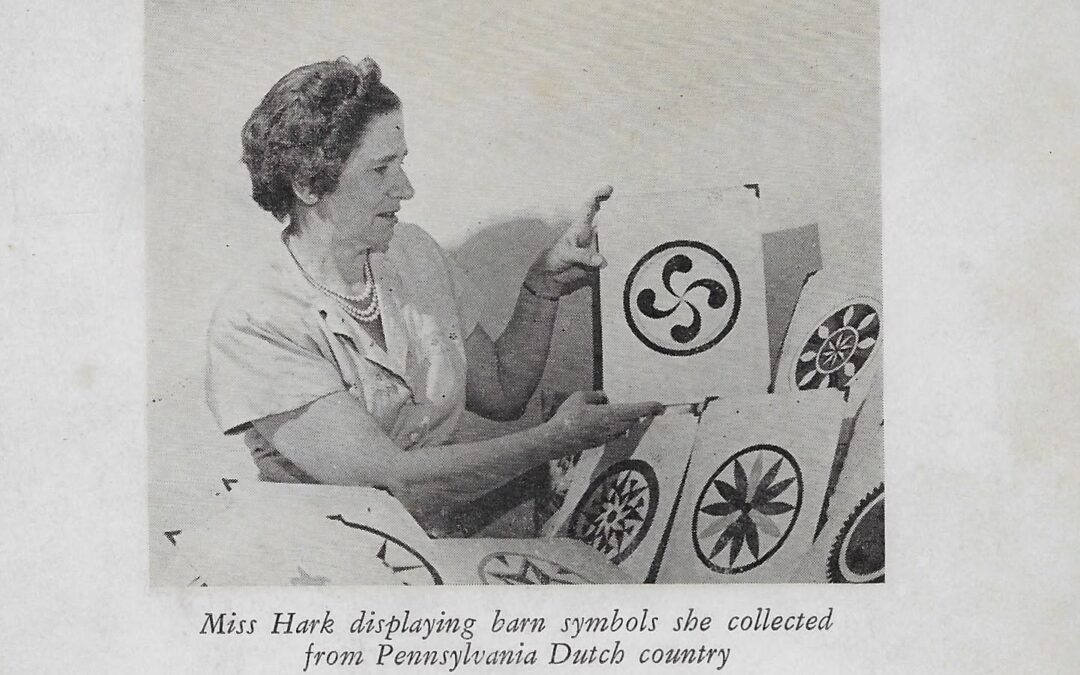
This article is based on a presentation at the Pennsylvania Chautauqua on July 9, 2004 featuring speakers Tom Meredith, Mary Alice Wheeler and Cindy Kercher.
Ann Hark made her living as a reporter for the Philadelphia Public Ledger, the Philadelphia Inquirer, feature writer for Ladies Home Journal, author of nine books, freelance writer and lecturer, and perhaps most importantly to the Lebanon Daily News audience, an interpreter of Pennsylvania German culture. Born in 1891 in Lancaster County, Anna Amelia Hark was the daughter of Moravian pastor, J. Max Hark, who served as the first chancellor of Mt. Gretna’s Pennsylvania Chautauqua and was one of its founding members. J. Max Hark moved his family to Bethlehem when he because President of the Moravian Seminary and College for Women, the oldest boarding school for girls in the United States. In 1905, the Harks bought several lots in Mt. Gretna and built their own summer cottage. Ann graduated from the seminary at nearly fourteen years of age, with the intention of writing poetry. She was quite athletic, known for her love of high-diving at Mt. Gretna’s Conewago Lake, horseback riding (not side-saddle), and tennis. At nineteen, Ann taught elementary age school girls back at the seminary for a year and a half, before moving to Lebanon in 1911, where her father was the pastor at the Lebanon Moravian Church. In Lebanon, she picked up shorthand, which would serve her well through the balance of her career.
Known as a fiercely independent and determined woman, Ann moved to Philadelphia with the intention of becoming a journalist. She landed a job at the Philadelphia Public Ledger. Of course, as a starting writer, she did not receive her own byline. Her father sold his Mt. Gretna properties in 1919. Having saved enough money by 1922, Ann bought the westernmost piece of property within the confines of Chautauqua.
While working at the Philadelphia Public Ledger, she met Byron Darnton, whom she married. Darnton was a World War I veteran, having served with the Red Arrow Division of the Michigan National Guard, which was the first to enter Germany at Alsace in 1918. They honeymooned in a tent on what is now referred to as the state gamelands, adjacent to Mt. Gretna. Darnton accepted a job with the New York Post in 1925, moved to the Associated Press in 1930 and finally, the New York Times in 1934. Ann and Byron’s divorce was final in 1930; Darnton married Eleanor Choate in 1938, with whom he had two sons, Robert and John. In 1942, he was killed in a bombing in New Guinea working as a war correspondent. General McArthur was so impressed with his work and grasp of the war situation, he personally reported Byron’s death to the Darnton family and the New York Times. Interestingly, while W.C. Fields is credited with the quote, “Any man who hates dogs and children can’t be all bad.” Rightfully, that quote belongs to Darnton, who made the statement to Cedric Worth (a writer for Harper’s Monthly) in an elevator leaving a party in 1930. Apparently, the major topic of conversation at that party was about a man who had a problem with dogs. Darnton is buried at the Port Moresby, New York Military Cemetery. His sons, Robert and John, later worked for the New York Times. John won a Pulitzer Prize in 1982 for his reports from Poland on the nation’s problems and the martial law crackdown; he still works for the Times. Robert is a professor of European History at Princeton University.
Hark changed employment in the 1920s, moving to the Philadelphia Inquirer where she covered everything from movies to murders. Still summering in Mt. Gretna, she was one of the first to own her own automobile, calling it “The Rat.” Working shortly for Ladies Home Journal, she returned to the Ledger in 1929 for a bigger paycheck, with a broader resume, having started her career as an independent writer. In 1932, under her own byline, she wrote a regular column in the Sunday supplement on notable women, as well as some short romantic pieces. Hark liked to write about subjects and surroundings with which she was personally familiar.
From 1936 to 1939, Ann published five books. The Seminary Secret (a juvenile mystery, as were her next two books) centered around life at a Moravian School in Bethlehem and a monkey who appeared there. (Hark kept a pet monkey during some of her residence in Mt. Gretna.) The Sugar Mill House and Island Treasure were set in the Virgin Islands, where her brother was a dental missionary in St. Croix, where she often visited and recuperated from an illness there. All three books were extremely well-received. Her first book for adults, Hex Marks the Spot, was released in 1938. Her most popular book had at least five printings and centered on central Pennsylvania German customs and culture. It was dedicated to her chauffeur, Jack Kelly. Dear to the hearts of Gretna-ites, her next book, The Phantom of the Forest was released in 1939; the story took place in Mt. Gretna’s old Conewago Hotel (which overlooked the lake) the year before the hotel was torn down.
The man whom Hark referred to as her chauffeur was Jack Kelly, a divorced gentleman who resided in Cynwyd and frequently took rooms at Mt. Gretna cottages when visiting Ann. They had at least a substantial bond of friendship and spent hours talking as he drove her around the area doing research for her books. In 1940, Mr. Kelly had a nervous breakdown; his physician recommended outdoor work to relieve his stress. Following a luncheon in Mt. Gretna later that year, Kelly supposedly left Mt. Gretna to apply for an outdoor job at the Gap. Upon return to her cottage later in the day, Ann found Kelly forty feet from her front door, having committed suicide with a revolver. Ann left her cottage and went into seclusion for a year, selling it in October 1941. She then made Philadelphia her year round permanent residence. By this time, she was making her living as a freelance writer, lecturer, and book author.
In 1943, her children’s book The Story of the Pennsylvania Dutch: A Children’s Book was published. Pennsylvania German Cookery: A Regional Cookbook, written with Muehlenberg College Professor, Dr. Preston Barba, was published in 1950. Blue Hills and Shoofly Pie was published in 1952, with the book dedicated to “her chauffeur and Patsy (her dog), who still ride with her today.” And in 1955, her final book Market House Mystery, situated in Lancaster’s southern market, was published. Ann continued to enjoy lecturing and freelancing, writing articles like “Moravian Christmas Traditions,” for various publications. She later moved to a trailer in Collegeville and passed away on April 9, 1970 at the age of 79. Hark’s summer cottage, now owned by Ed and Cindy Kercher, can be seen from Rt. 117, directly across from Lake Conewago. Kathy Snavely is the chair of the Lebanon County Commission for Women.