
Originally published by Lebanon Valley College in The Valley
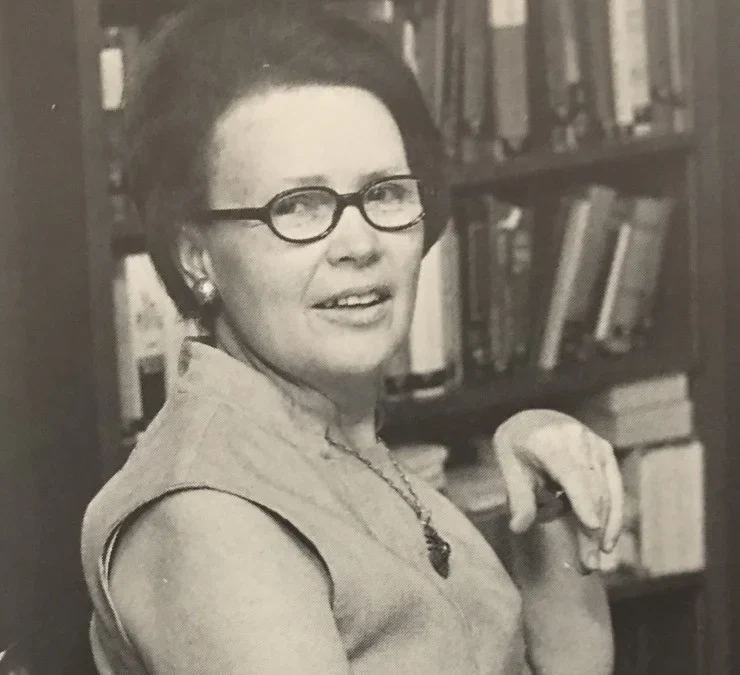
Dr. Jean O. Love, professor emerita of psychology, died Dec. 26, 2015, in Lebanon at the age of 95. A U.S. Navy veteran who served during World War II, Dr. Love was a nationally recognized scholar of Virginia Woolf. Dr. Love retired from LVC in 1985 after more than 30 years on the faculty (1954-1985), including as chair of the Psychology Department (1954-1970). In 1985, the College established The Jean O. Love Award for Outstanding Achievement in Psychology in her honor.
“During her tenure as its chairman, Jean built the Department of Psychology into a highly visible and important part of the College,” wrote Dr. Agnes O’Donnell, late professor emerita of English, in 1985. “Under her leadership, a competent and innovative staff developed a sound program that not only attracted students but also sent them off, year after year, for graduate study at major universities or into jobs with counseling and social service agencies.”
Dr. Kristen Angstadt ’74, vice chair of the College’s Board of Trustees, who went on to earn her master’s degree and doctorate in psychology from the University of Maryland, was one such student. Dr. Angstadt, who along with her late husband, David A. Hoffman, M.D., named a Psychology Department faculty office in Dr. Love’s honor, was strongly influenced by Dr. Love’s teaching.
“Over the decades, as our relationship grew from professor-student to colleague-friend, I was inspired to an even greater degree by her forward thinking and the passion she exuded in her teaching, her writing, and her painting, as well as the compassion she extended to her colleagues and friends,” Dr. Angstadt noted. “Moreover, she did all this with subtle humor, generosity, and kindness. To me, she was not merely a role model, but an individual who exemplified the words of Henry David Thoreau – ‘to him whose elastic and vigorous thought keeps pace with the sun, the day is perpetual morning.'”
Among her many accomplishments, Dr. Love listed having the Psychology Department classified with the natural sciences at LVC, rather than the social sciences, as among her proudest achievements. She also served, by Congressional appointment, as a delegate to the White House Conference on Education, Health, and Welfare, and oversaw the founding of a campus chapter of Psi Chi. the national honor society in psychology.
Dr. Jean Olivia Love was born Feb. 27, 1920, in York County, S.C. Educated in York County public schools, she went on to earn her bachelor’s degree from Erskine College, her master’s degree from Winthrop College, and her doctorate from the University of North Carolina at Chapel Hill. She pursued post-doctoral study at the Institute of Experimental Psychology at Oxford University in England, and at the Heinz Werner Institute of Developmental Psychology at Clark University in Worcester, Mass.
Dr. Love was a serious amateur painter, working in watercolors, oils, and mixed media. She had several one-person shows in the Lebanon area, and exhibited in local, state, and regional juried exhibitions.
Although she loved the life of teacher and scholar, Dr. Love was proudest of two studies she wrote about the English writer Virginia Woolf, specifically how the writer’s madness could be traced in her novels. The University of California Press published Love’s books, Worlds of Consciousness and Virginia Woolf: Sources of Madness and Art, in 1970 and 1978, respectively. The latter, in particular, brought Dr. Love national recognition as a Woolf scholar, resulting in invited papers and membership on panels such as at the Modern Language Association Meeting in 1980, and at the University of Michigan’s Conference on Biography, where she was the keynote speaker.
In 1998, Dr. Love donated her Virginia Woolf collection to the Vernon and Doris Bishop Library at the College. It remains on display in the Elaine Frock ’48 Conference Room.
Dr. Love moved to Cornwall Manor soon after the death of her husband, Albert W. “Rudy” Blecker Sr., in 1996. At Cornwall, she was active in civic and religious activities and traveled frequently to Europe.
“She attained her position of respect ‘the hard way’: she earned it,” said Dr. O’Donnell in a 1985 article in The Valley.